Margins are tightening. Payment channels multiplying. And even accidentally mishandling protected health information (PHI) can expose providers to steep regulatory penalties and reputational damage.
Healthcare payments have never been riskier—or more complex. Yet patient expectations for simplicity and convenience have never been higher.
Other industries have conditioned consumers to expect fast, digital-first payment experiences with every purchase. In healthcare, however, regulatory safeguards make “easy” far more complicated.
How does HIPAA define protected health information (PHI)?
Protected health information is individually identifiable health information held or transmitted by a covered entity or its business associate. It includes information about a patient’s past, present, or future physical or mental health, the care they receive, or payment for that care.
Examples of PHI include names, phone numbers, email addresses, birth dates, and other identifying details tied to health information.
Covered entities include healthcare providers, health plans, and healthcare clearinghouses. Business associates are separate organizations or individuals that create, receive, maintain, or transmit PHI on behalf of a covered entity.
Is PCI compliance enough for healthcare payments?
Most businesses must navigate a growing list of financial and data security standards — PCI compliance chief among them. For healthcare providers, that list is longer and more complex.
Any payment workflow that involves PHI must also meet HIPAA privacy and security requirements — and depending on the organization, standards like HITRUST may apply as well.
This creates a high-stakes dual obligation: protecting cardholder and patient data. And that’s what makes choosing a healthcare payment processing partner so challenging. How can you ensure the solutions you evaluate meet both sets of requirements?
The following guide and checklist show healthcare leaders how to choose a payment processor that meets both HIPAA and PCI requirements. But first: why is adhering to both frameworks so critical?
PCI and HIPAA compliance explained: Why healthcare providers need both
Many providers assume PCI compliance is enough. But since healthcare payments touch both cardholder data and PHI, two separate sets of safeguards must be in place. And this PCI vs. HIPAA healthcare payments gap is where many organizations unknowingly fall short.
What is PCI-compliant payment processing?
PCI protects cardholder data. PCI compliant payment processing adheres to the Payment Card Industry Data Security Standard (PCI DSS) — the technical and operational safeguards organizations must implement to securely process, store, and transmit credit and debit card information.
What is HIPAA-compliant payment processing?
HIPAA safeguards a patient’s sensitive protected health information (PHI). HIPAA compliant payment processing is the practice of accepting, storing, and transmitting payments in a way that meets all required security, privacy, and regulatory standards for the healthcare industry.
Since healthcare payments touch both patient cardholder data and protected health information (PHI), providers must have both PCI and HIPAA safeguards in place.
Why HIPAA + PCI both matter for healthcare payments
Digital payments are rapidly accelerating and expanding. Patients today swipe, dip, tap, and click their way through online portals, text-to-pay links, mobile devices, and automated recurring billing cycles.
But more ways to pay also means more ways to be attacked. And whether they realize it or not, organizations that rely on PCI compliance alone are significantly exposed.
PCI protects cardholder data. HIPAA protects patient data. Healthcare payments require both, and violations are costly:
- Financial penalties that can exceed hundreds of thousands of dollars
- Legal exposure tied to PHI breaches
- Operational disruption from system downtime and breach remediation
- Reputational damage that erodes patient trust for years
Payment security used to be considered an IT issue or a back-office function, but now, it’s a leadership priority.
The risks of HIPAA and PCI noncompliance
Since October 31, 2024, HHS has received 374,321 HIPAA complaints. Up to $500,000 can be levied for each incident, with maximum penalty caps of up to $1.5 million for all violations of an identical provision during a calendar year.
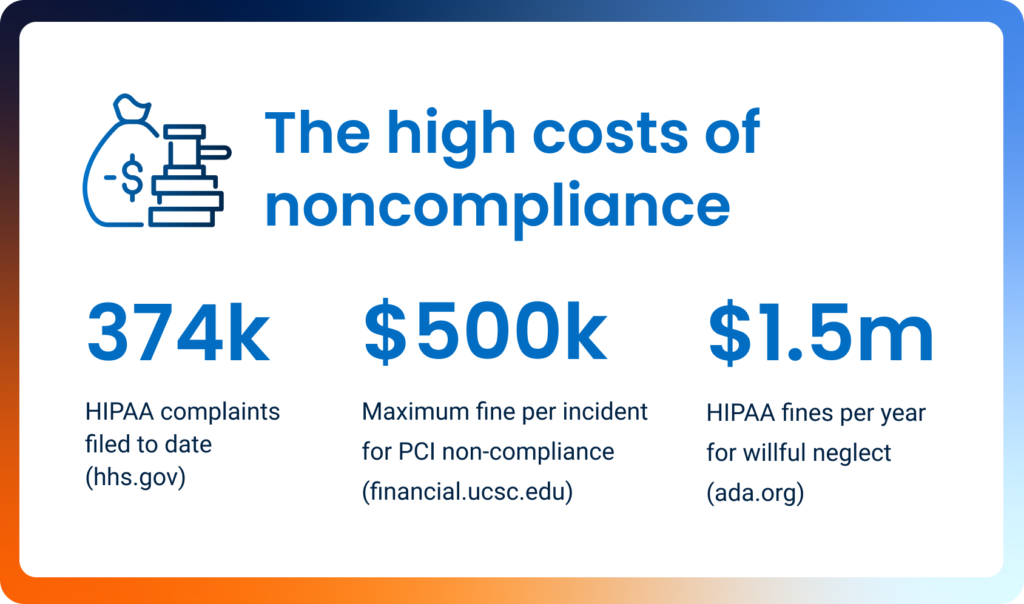
The possibility of substantial fines like these is enough for most organizations to prioritize both HIPAA and PCI compliance. But exposure can also lead to revenue interruption, frozen payments, higher insurance premiums, and reputational risk.
Adding insult to injury, IBM’s Cost of a Data Breach Report notes that healthcare breaches can take nearly 280 days to identify and contain, increasing operational disruption and recovery costs.
Beyond compliance: The business impact of HIPAA- and PCI-compliant healthcare payments
Compliance is required. But the advantages of getting it right go further than avoiding penalties. Here are ways HIPAA- and PCI-compliant payments improve the business of healthcare:
- Maintains patient trust: Patients assume their information is protected. A single breach can permanently weaken that trust.
- Mitigates cyber threats: Healthcare remains one of the most targeted sectors by cybercriminals. Payments are a high value target.
- Reduces compliance risk: HIPAA and state regulators are increasingly aggressive. Violations are costly and highly public.
- Improves operational efficiency: Disconnected systems force staff into manual reconciliation, duplicate data entry, and constant oversight.
- Unlocks cash flow: Automated, compliant systems accelerate payment posting, reduce errors, and shorten reimbursement cycles.
These benefits are real — but they don’t remove responsibility. In healthcare, compliance outcomes ultimately rest with the organization itself.
⚠︎ WARNING: HIPAA training doesn’t equal HIPAA-compliant payments
Completing HIPAA training and risk assessments doesn’t automatically make your practice’s payment workflows compliant.
WHY? Federal regulations — including HITECH — extend compliance to every vendor that touches protected health information (PHI), including your payment processor.
Many payment platforms started in retail and later moved into healthcare—without fully addressing healthcare-specific risks. That can leave gaps in safeguards like role-based access, audit logs, and Business Associate Agreements (BAAs).
BOTTOM LINE: Internal compliance only goes so far. If your payment software isn’t built for healthcare, your practice may be exposed.
The three pillars of HIPAA-compliant healthcare payments
Here’s how to know if the payment solution you’re considering covers all the bases.
1. Patient data (PHI) is protected
HIPAA-compliant payment systems must be intentionally designed to minimize and safeguard PHI by:
- Collecting only the HIPAA-defined “minimum necessary” data
- Keeping clinical and financial data strictly segregated
- Maintaining audit logs to trace access, changes, and movement of PHI
- Enforcing documented policies for PHI handling
2. Security protocols and controls are clear
Vendors must demonstrate maturity across multiple layers of security, including:
- Regular security testing and risk assessments
- A signed and actively maintained Business Associate Agreement (BAA)
- Strong authentication and role-based access
- Encryption and tokenization to minimize PHI and card data exposure
- Comprehensive audit logging
Without them, you can introduce organizational risk.
3. Workflows are designed for healthcare
Healthcare payments require more than secure rails. They must be built specifically for clinical environments:
- No manual rekeying
- Connections to PMS/EHR to reduce manual steps
- Payment networks designed for healthcare
- PHI-safe links, portals, and communications
When systems aren’t designed for healthcare, staff end up bridging the gaps with manual workarounds, creating both operational inefficiency and compliance exposure.
Checklist: What to look for in a HIPAA- and PCI-compliant payment partner
Viable healthcare payments partners must demonstrate clear HIPAA and PCI compliance and operational value. Meeting the criteria below should be non-negotiable.
The following criteria help healthcare leaders evaluate whether a payment platform is truly compliant and audit-ready.
Beyond regulatory requirements, we’ve included essential features and functionality to help you confidently choose a best-in-class healthcare payment processing solution.
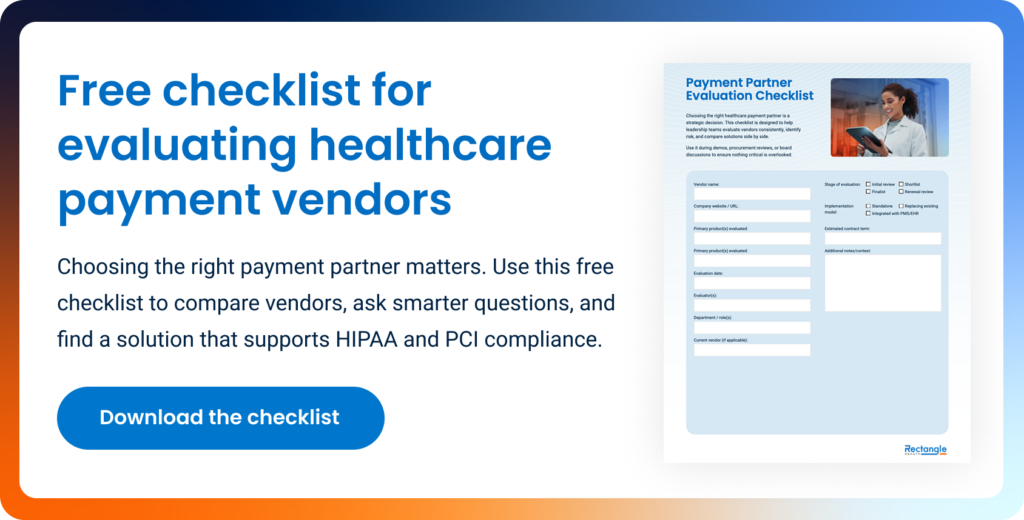
You can download the checklist here.
Compliance and accountability
At the very least, your healthcare payment solution must keep your organization HIPAA- and PCI-compliant. The best partners also demonstrate accountability and audit readiness through BAAs and other documentation.
Some payment vendors may claim healthcare readiness but rely on PCI compliance alone. Others may suggest their platform is appropriate for the healthcare industry, despite not being purpose-built for it. Both gaps can expose organizations to significant risk.
What to look for |
What to ask |
|
|
After you’re confident compliance is covered, use the tips below to make sure potential partners meet other baseline criteria for best-in-class payment solutions.
Connectivity and automation
Healthcare organizations waste $760-935 billion each year due to payment and claims inefficiencies. AR (accounts receivable) automation not only eliminates hours of chasing payments; it prevents the inevitable costly errors that arise from even the most rigid manual workflows.
Ask potential payment partners about their ability to automate tasks that monopolize staff time that would be better spent on patient care. Then make sure you understand precisely what the solution automates — and what it doesn’t.
What to look for |
What to ask |
|
|
Scalability
Whether your organization is a fast-growing regional practice or an enterprise expanding into new regions, ripping and replacing technology taps the brakes on growth.
The payment solution you choose should allow you to scale effortlessly and easily adapt to an always-changing regulatory landscape. It also should make it easy to add team members or adjust their roles as needed.
What to look for |
What to ask |
|
|
Demonstrated outcomes
Evidence builds confidence and reinforces credibility. Ask potential vendors for case studies, customer testimonials, and performance data. Research reviews from verified users on third-party platforms. And document the return your team should expect from your investment.
What to look for |
What to ask |
|
|
Next-level automation: Reimbursement
Patient payments are only half of accounts receivable. Automating reimbursements — processing insurance payments electronically, standardizing Explanation of Payments (EOPs), and automatically posting payments to patient accounts — completes the AR cycle and removes manual follow-up.
The right payment partner is a strategic advantage
Healthcare payments are no longer just an administrative function — they can be used as a significant strategic advantage. Plus, PCI- and HIPAA-compliant healthcare payments ensure privacy, security, and trust.
The best payment partner for most healthcare organizations deliver:
- Single healthcare-ready platform
- Built-in HIPAA and PCI compliance by design
- Minimal manual handling
- Clear audit trails
- Vendor accountability baked in
The best leadership teams know better than to delay improvements to payment processes and compliance.
They reevaluate their payment partners to ensure they can support compliance mandates today, strengthen operational efficiency tomorrow, and scale seamlessly as regulations and patient expectations continue to evolve.